


 +353 24 904 96


How do I choose the right LED strip light for my needs?


Choosing the right type of LED strip is not an easy task, you must analyze specific technical
details and specifications to choose the perfect strip for your lighting project. Whether you need accent lighting or a primary light source, factors like brightness, total wattage, and color temperature will determine the final desired lighting effect.
Table of Contents
- How to determine the purpose of your led strip lights?
- How much lumen output is required for different lighting effects?
- Which color temperature is best for residential and commercial spaces?
- How to manage power supply and excessive voltage drop?
- Technical Performance Table
- Summary: Ensuring a successful led strip installation
- FAQ: Professional LED Strip Guide
How to determine the purpose of your led strip lights?
The purpose of your led strip lights is determined by whether the application requires functional illumination, such as cabinet lighting, or mood lighting for aesthetic enhancement. Identifying the installation area first allows you to choose between high density strip options for task work or lower output ribbon lights for accent lighting.
First of all you need to consider which use you are going to give to LED strips light. Do you want a practical light for a workspace, office…? Or maybe you prefer a decorative light strip for the living room to create a specific mood lighting. For kitchen cabinets, a natural white output is often preferred, while residential use in hallways might only require a soft glow.
How much lumen output is required for different lighting effects?
For decorative accent lighting, a lumen output of 1000 lumens/metre is sufficient, whereas main lighting for commercial spaces requires over 2000 lumens/metre. Accurately calculating the lumen output per metre ensures you have enough brightness to replace traditional light bulbs or spots.

Apart from the use of the strips, make sure how much light you are going to need. One normal spot light gives around 400 or 500 lumens. Our LED strip model SPE 168 Natural White (indoor and outdoor) gives 2400 lumens/metre. So for each metre of strip it will give the same brightness as 5 normal spots. There is a wide range of led lights available, from 500 lumens per metre to 2400 lumens per metre, allowing you to accurately measure the brightness levels for any space.
Which color temperature is best for residential and commercial spaces?
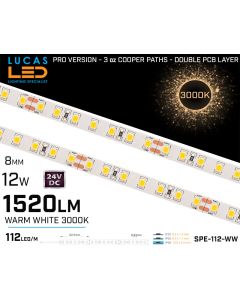
Residential spaces benefit from warm white (2200K - 3000K) to create a cosy atmosphere, while commercial applications require cool white (6000K+) for high visibility. Selecting the correct color temperature is vital for how the white light or natural daylight appears in the installation area.Then you'll need to choose the colour temperature of the LED strip lights. We have to offer 5 different white colours:
Warm colours (2200k - 3000k) are specially used for cosy and comfortable spaces like the living room, hallway, making the area more comfortable, so these colours are more used for decoration or making a specific ambience.

For practical purposes it is most common to use Natural White (4000k), to have a simulated natural light. Usually used for Kitchen cabinets, workspaces…

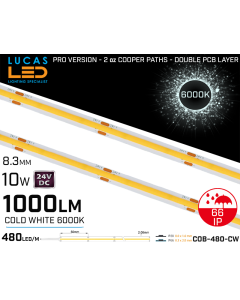
And what about the Cold White? Well, Cold White lights are used for areas which need a strong light, like offices, business and places where a bright visibility is essential for selling something or only to have a better ambience for the workers.
How to manage power supply and excessive voltage drop?
To manage excessive voltage drop in larger installations, you must use a 24V power supply and inject power at both ends of the strip if the total length exceeds 5 to 10 metres. Ensuring the wattage rating of your power source is 20% higher than the total wattage of the led strip prevents overheating and system failure.
When buying led strip lights, you must calculate the total length and total wattage. For larger installations, you might need multiple strips connected to a single power supply. Using aluminum channels as a heat sink is extremely easy and essential for high-power led chips. For outdoor applications, ensure the strip has a protective coating and use proper end caps to seal the strip segments.
Technical Performance Table
|
Feature |
Decorative Lighting |
Main / Task Lighting |
|
Lumen Output |
500 - 1000 lm/m |
2000 - 2400+ lm/m |
|
Typical Wattage |
4.8W - 9.6W per metre |
14.4W - 24W per metre |
|
LED Density |
Low Density |
High Density Strip (120+ LEDs/m) |
|
Voltage |
12V DC |
24V DC (Recommended) |
|
Applications |
Accent Lighting |
Commercial Spaces / kitchens |
Summary: Ensuring a successful led strip installation
A successful installation requires matching the lumen output to the space's needs while ensuring the power supply can handle the total wattage without excessive voltage drop. By using aluminum channels for heat dissipation and mounting clips or adhesive backing for secure placement, you can create continuous lighting that lasts. Always double check the maximum length of the led strip before connecting it to the power cord to ensure the light appears consistent across the entire surface.

FAQ: Professional LED Strip Guide
Which is brighter, 4000K or 6000K?
Technicznie 6000K (Cool White) often appears brighter to the human eye due to its higher blue light spectrum content, although the actual lumen output might be identical to a 4000K strip.
Are 12V or 24V LED strip lights better?
24V LED strip lights are superior for larger installations because they suffer less from excessive voltage drop, allowing for longer maximum length runs compared to 12V systems.
Which is better, 5050 or 2835 LED lights?
2835 LED chips are generally more efficient and offer better heat dissipation, allowing for a higher density and more continuous lighting effect than the older 5050 chips.
Is RGB or RGBW better?
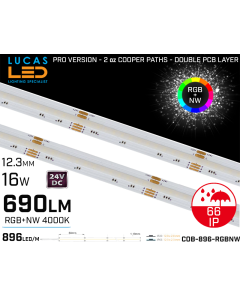
RGBW is better because it includes a dedicated white light chip, providing a pure natural white or warm white, whereas standard RGB strips create a "muddy" white by mixing multiple colors.
About the Author